Buyer Guides
The £8,000 Mistake: What Really Happens When You Buy a Car Still on Finance
Rhiane Moss is 19, a Law student at the University of Liverpool, and the last person you'd expect to lose nearly £8,000 in a used car scam. She did everything right — except check whether the seller actually owned what he was selling. This is her story.

Ricki Angel
Founder, BuyCarCheck · 15 May 2026 · 6 min read
When I started BuyCarCheck, I had a rough sense of the scale of the hidden-finance problem — you'd see it in the forums, in the stats, in the occasional news story. What I didn't fully appreciate was how ordinary the victims are: not naive, not careless, just people who didn't know what they didn't know, doing everything any reasonable buyer would do and still ending up with nothing.
As part of our ongoing research into the real experiences of UK used car buyers, I reached out to people in the mid-range buying bracket — the kind of buyers who saved up, did their homework, and still got caught out — and the stories that came back were more troubling than I expected. This one, from Rhiane, is the one I keep coming back to.
— Ricki Angel, Founder, BuyCarCheck
Meet Rhiane

Rhiane Moss is 19 and entering her third year studying Law at the University of Liverpool. She works part-time at a coffee shop — the same one she started at in sixth form — and for over a year before buying her first car, she had been quietly setting aside whatever she could from each shift.
“I wanted something that felt like mine,” she told me. “I'd been borrowing my mum's car for placements and it just felt like I was still a kid. I wanted my own car — something I could drive to interviews when I graduate.”
By April 2026, she had saved £3,000, and her parents contributed £4,800 — a combined birthday and Christmas present they had been quietly planning for months — bringing her total budget to £7,800, not a trivial amount for someone who had spent over a year building it up, shift by shift, with one eye already on graduation.
The listing that looked perfect
She found it on a Sunday evening on Facebook Marketplace — a 2021 Volkswagen Polo R-Line TSI, midnight black with a matching interior, 19,800 miles on the clock, listed at £8,400 by a private seller in Belle Vale, a quiet residential area about thirty minutes from Liverpool city centre. The photos were clear, the description detailed, and the price — for what it was — more than reasonable. “I didn't want a banger!” she said.
She messaged the seller (let's call him Craig), a well-spoken chap in his early thirties. Craig replied within the hour from what she now knows was a burner mobile number, and he had a pretty convincing back story: upgrading to an SUV now that his girlfriend had moved in, full service history, owned it since new. Was she interested in a viewing?
Her dad came with her the following Saturday, and by every measure the viewing went well — Craig answered every question without hesitation, produced receipts from a Volkswagen dealership, and let them take their time on the test drive. The car drove perfectly. They offered £7,800, and he accepted without much resistance.
“Everything about it felt right,” she said. “He wasn't pushy. He wasn't rushing us. My dad came away thinking he seemed genuine. So did I.” And truth be told, there was actually nothing wrong physically or mechanically with the vehicle — it was worth the amount advertised.
The purchase
Rhiane transferred £7,800 by bank transfer that afternoon. Craig handed over the keys and the V5C and she drove it home, her parents taking photos in the driveway.
She insured it that afternoon, took her friends out for a spin test drive and a Sunday pub lunch, and they loved it just as much as she did.
Seven weeks later
A letter arrived at Rhiane's house, addressed to her — the now registered keeper. It was from Black Horse Finance, Lloyds Bank's automotive lending arm, and it stated there was an outstanding balance of £5,900 on a PCP agreement secured against the vehicle.
“I genuinely didn't understand what I was reading at first,” she said. “I thought it was some kind of mistake. Then I Googled it.”
What the letter meant
Under the Consumer Credit Act 1974, a car purchased on a PCP or HP agreement is legally owned by the finance company — not the person making monthly payments. Craig had not settled his agreement before selling. The car was never legally his to sell. The finance company still owned it. In essence, Craig pocketed the £8,000 but did not use it to clear the remaining debt with the credit provider — so the outstanding balance of £5,900 now belonged to the registered keeper. Rhiane.
The morning she found it gone
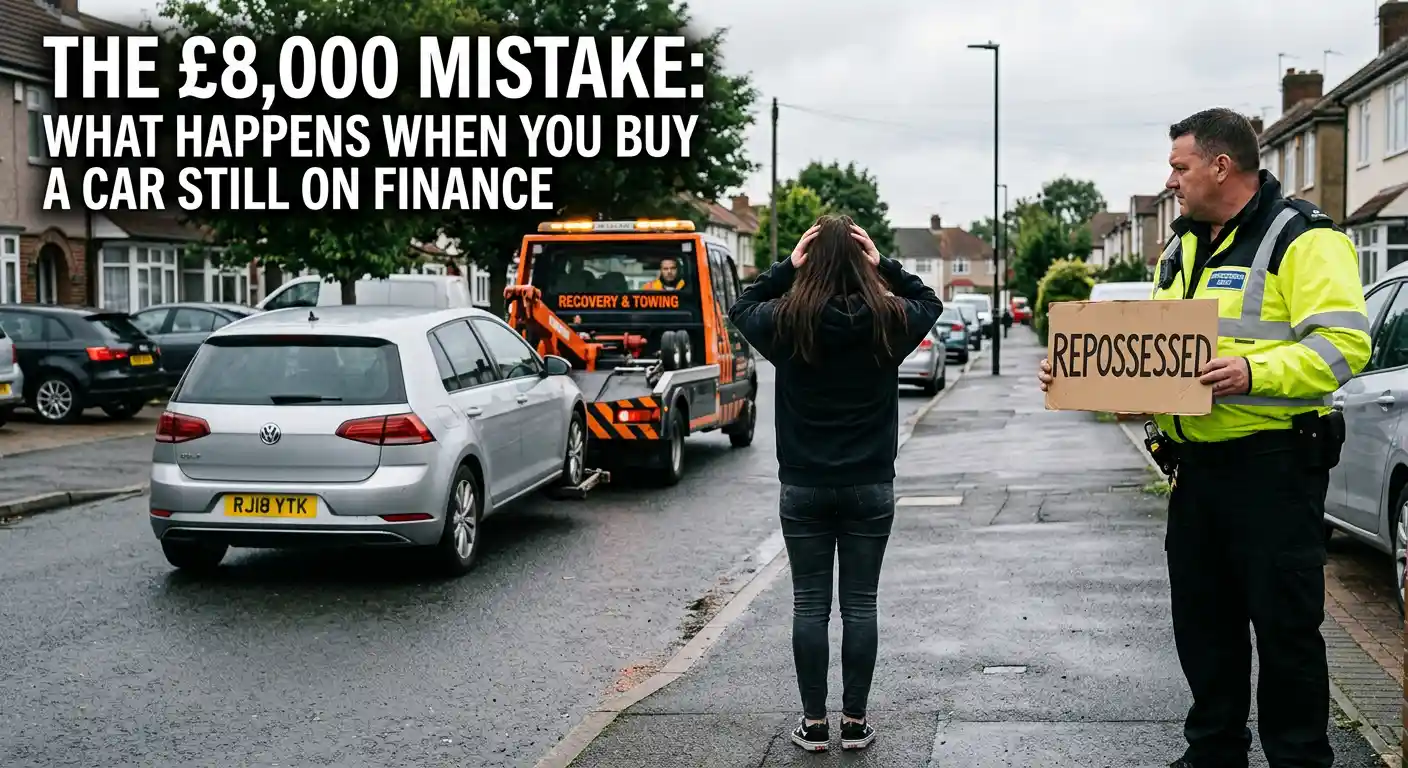
Three weeks after the letter, on a Friday morning, Rhiane walked down to the car park beneath her student accommodation and the space was empty. A recovery agent, acting on instructions from Black Horse Finance, had collected the vehicle overnight using the address from the DVLA registration records.
She called the police. They told her it was a civil matter. She called Craig's number. It was disconnected. She checked Facebook. His account was gone.
“I sat in the car park for about twenty minutes,” she said. “Not because I thought the car was coming back. I just didn't know what to do next.”
Her parents' £4,800 was gone, along with the £3,000 she had put in herself — over a year of her own savings. The insurance premium she'd already paid. Gone. The car was gone with it. And to top it all, she graduates next month with a £70,000 student debt already hanging over her.
“To this day, I still haven't told my parents. I am absolutely devastated.”
The 'innocent purchaser' defence — and why it often fails
There is a legal principle called the bona fide purchaser for value without notice — roughly, if you bought in good faith without knowledge of the outstanding finance, a court may allow you to keep the vehicle. It sounds protective. In practice it is inconsistently applied and rarely straightforward to invoke.
Finance companies argue that buyers had the means to check — via an HPI or similar service — and chose not to. Courts have found against buyers on exactly this basis. “You should have checked” is a legally robust position, and finance companies use it routinely.
Small Claims Court rarely helps
Pursuing Craig through the courts requires tracing him first. By the time most victims attempt this, the seller has moved on. Even with a judgement, enforcing it against someone with no traceable assets is effectively impossible. Rhiane has not recovered a penny.
What a £4.99 check would have shown
A full vehicle history check on that Polo's registration would have flagged the outstanding finance agreement immediately. Finance data in the UK is held by Experian and HPI — updated in real time as agreements are created and settled. No lag, no delay. It would have shown up.
The check takes 30 seconds. It costs £4.99. It would have saved Rhiane £7,800 and eighteen months of her life.
What a BuyCarCheck full history check reveals
Outstanding finance (PCP, HP, lease)
Would have flaggedInsurance write-off category (Cat S / Cat N)
IncludedStolen vehicle (PNC database)
IncludedNumber of previous registered keepers
IncludedV5C last issued date
IncludedFull MOT history with mileage at every test
IncludedIf it has already happened to you
Do not hand the vehicle over voluntarily
You have the right to contest the repossession. Do not surrender the car until you have taken legal advice. A recovery agent arriving at your home does not have the right to enter private property to seize a vehicle without a court order.
Contact the finance company directly
Ask for a copy of the finance agreement and confirm the outstanding balance. Some companies will pursue the original seller for the shortfall rather than repossessing from you, particularly if you can demonstrate you bought in good faith.
Report to Action Fraud
This is fraud, not just a civil dispute. File a report at actionfraud.police.uk. A crime reference number strengthens your legal position and puts the seller's behaviour on record.
Contact Citizens Advice
Citizens Advice can help you understand whether the innocent purchaser defence applies in your specific case and what steps to take next.
Pursue the seller via Small Claims Court
If you can trace the seller, a claim through the small claims court (up to £10,000) is relatively low-cost. Secure the judgement first — enforcement can be pursued later if and when the seller is located.
“Rhiane's story is not unusual. It is not even particularly dramatic compared to some of the accounts we've heard. What makes it worth publishing is exactly how ordinary it was — a careful, sensible young woman entering her final year, accompanied by her dad, doing everything right except the one thing that would have stopped it. When she graduates she won't just be carrying student debt. She'll be carrying this too.”
— Ricki Angel
Found this useful?
A £4.99 check could save you thousands
Run a free basic check, or save money with a bundle — check three cars for just £11.99
Check before you buy
Finance · Write-off · Stolen · Keeper history