Buyer Guides
Clocking Gangs: How Organised Crime Is Rolling Back Digital Odometers
One in sixteen used cars on the UK market is estimated to carry a falsified odometer reading. What started as a screwdriver and a steady hand is now an organised, digital operation — and the port that was supposed to make clocking impossible has become the very thing that makes it trivially easy.

Lefteris (Leebo)
Vehicle Enthusiast, BuyCarCheck · 29 May 2026 · 7 min read

The fraud that never went away
Odometer fraud — clocking — is one of the oldest scams in the used car market. For decades, people assumed the switch to digital dashboards had killed it. After all, you can't just wind back a digital number with a screwdriver and a steady hand. The reading is stored in the ECU, the instrument cluster, the gearbox control unit. It is immutable. Or so the story went.
The story was wrong. Clocking did not disappear when cars went digital. It evolved. And what it evolved into is more organised, more scalable, and harder to detect than anything that came before it.
An estimated 1 in 16 used cars on the UK market today carries a falsified odometer reading. That is approximately 400,000 vehicles changing hands every year with manipulated mileage. The average rollback is around 60,000 miles. The average uplift in sale value: £2,000 to £4,000 per vehicle.
How it started: the analogue era
The original method was almost laughably simple. Analogue odometers used a physical gear mechanism to count wheel rotations and advance a set of numbered rollers. All you needed to reverse the count was access to the instrument cluster and a drill or cable attachment that could spin the mechanism backwards. A job a mechanic could do in twenty minutes.
It was low-skill, low-cost, and virtually undetectable to the average buyer. The only tell was physical wear on the car that didn't match the mileage on the dial — worn steering wheel leather, a sagging driver's seat, clutch pedal rubber worn to the metal.
Legislation eventually made it a criminal offence, but prosecution was difficult and the practice was rampant throughout the 1980s and 1990s. Estimates from that era suggest up to a third of used cars on the UK market had clocked mileage.
Why everyone assumed digital fixed it
Modern cars store mileage data in multiple locations simultaneously: the instrument cluster, the engine control unit (ECU), the ABS module, the airbag control unit, the gearbox controller. The assumption was that to successfully clock a car, you'd need to update all of these consistently — an impossible task without deep access to the vehicle's architecture.
That assumption held for perhaps a decade. Then the tools caught up.
The OBD tool that changed everything
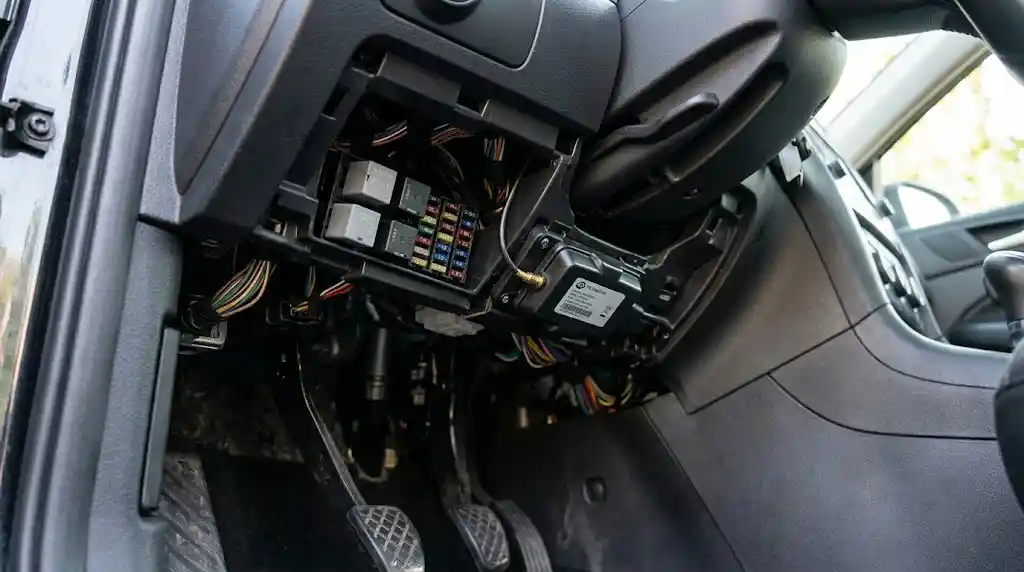
Every car sold in the UK since 2001 is legally required to have an OBD-II (On-Board Diagnostics) port — a standardised socket, usually located beneath the dashboard, that allows mechanics to read fault codes and communicate with the vehicle's electronic systems. It was designed for legitimate servicing and diagnostics.
The same port is now the entry point for professional odometer correction tools — devices that plug into the OBD socket and rewrite the mileage values stored across multiple control units simultaneously. The technology is openly sold online. A capable device costs between £300 and £2,000. Operators can be trained to use it in an afternoon.
How a professional clocking job works today
Vehicle is sourced with high genuine mileage — typically an ex-fleet car, ex-taxi, or high-mileage private sale.
OBD correction tool is connected. Mileage values are rewritten across all control units to a target figure.
The instrument cluster is removed and physically replaced or recalibrated if the digits show obvious wear.
Service history stamps are forged or selectively removed to match the new mileage narrative.
The car is advertised privately at a price that reflects the false — lower — mileage.
This is not a lone cowboy operation
The modern clocking operation is structured. Police investigations have uncovered networks that source vehicles at auction — often ex-fleet or rental returns with 80,000 to 120,000 genuine miles — and process them through a chain: a technician to rewrite the electronics, a hand to forge or replace the service history, and a network of private sellers who list the cars individually so that no single seller's name appears suspiciously often.
The economics are straightforward. A 2019 Ford Focus with 110,000 miles fetches perhaps £7,500 at trade. The same car with 35,000 miles can be listed privately for £11,500. After the cost of the clocking tool (amortised across dozens of jobs) and modest forgery costs, the uplift per vehicle is £3,000 to £4,500. A small operation running ten vehicles a month generates £35,000 to £45,000 in fraudulent profit.
Larger networks, operating across multiple cities with rotating inventory sources, are believed to be turning over millions of pounds annually. Convictions happen — but slowly, and the technical barrier to entry for clocking is low enough that new operators replace those who are caught.
Eight ways to spot a clocked car
MOT mileage inconsistency
The most reliable tell. Every MOT test records the odometer reading. A car that shows 34,000 miles on its last MOT but is now listed at 28,000 has been clocked — numbers cannot go backwards legitimately.
Service stamps with gaps
Look at the service history chronologically. Gaps in stamps, mismatched mileage between entries, or stamps that look newer than the paper they are on are serious red flags.
Wear that doesn't match the mileage
Worn steering wheel leather, a heavily depressed accelerator pedal, driver's seat bolster wear, and clutch pedal rubber worn flat are all signs of genuine high mileage — regardless of what the dash says.
Brand-new steering wheel or pedals
Conversely, a low-mileage car with suspiciously new-looking pedal rubbers or a recently replaced steering wheel cover may have had visible wear removed.
Instrument cluster replacement
Check the back of the instrument cluster surround for screw marks or slight panel gaps suggesting removal. Replacement clusters sometimes show a fractional mismatch in the dash lighting tone.
Tyre wear inconsistency
Original tyres on a car claiming 28,000 miles should still have significant tread. If the tyres are newer replacements on a supposedly low-mileage car, ask why they needed changing.
Price noticeably below market
A clocked car is priced to sell quickly. If a car's mileage and condition look impeccable but the asking price is 10–15% below comparable listings, the mileage may be the reason it looks so good.
Seller reluctant to provide history
Any resistance to sharing the full service book, receipts, or MOT certificate is a red flag. Legitimate sellers want to demonstrate their car's provenance — fraudulent ones obstruct it.
The MOT history is your best weapon
The DVSA (Driver and Vehicle Standards Agency) records the odometer reading at every MOT test and stores it in a national database that is free to access and cannot be altered by sellers. This mileage timeline is the single most reliable way to catch a clocked car.
A legitimate car will show a consistent, upward mileage progression across every test — the numbers only ever go up, and at a rate broadly consistent with typical annual usage. A clocked car will show a spike (the genuine high mileage recorded when it was last tested before clocking) followed by a sudden and impossible drop.
Example: clocked mileage timeline
2019 MOT
22,400 miles
2020 MOT
39,100 miles
2021 MOT
58,700 miles
2022 MOT
79,300 miles
2023 MOT
101,900 miles
Listed for sale
34,000 miles
A full vehicle history check from BuyCarCheck surfaces this timeline alongside the DVSA data, finance records, stolen flags, and keeper history — everything you need before you hand over a penny.
Before you buy
Check the MOT history first — it's free
gov.uk/check-mot-history gives you the mileage at every test for any UK vehicle. Takes 30 seconds. Do this before you even arrange a viewing.
Run a full vehicle history check
A paid check adds finance, stolen, write-off, and keeper data alongside the MOT mileage timeline. If the numbers don't stack up, the check will show it.
Cross-reference service stamps with MOT mileage
At the viewing, take the service book and compare each stamp date and mileage against the DVSA records. A legitimate history is internally consistent. A forged one rarely is.
Trust wear over numbers
The odometer can lie. Worn pedal rubbers, a sagging driver's seat, and deeply indented steering wheel leather cannot. If the wear doesn't match the mileage, it hasn't.
Found this useful?
A £4.99 check could save you thousands
Run a free basic check, or save money with a bundle — check three cars for just £11.99
Check before you buy
Finance · Write-off · Stolen · Keeper history