Buyer Guides
Why That "Cheap" Car Is 300 Miles Away: The Distance-Seller Red Flag
The exact spec, the right colour, £1,500 under everything comparable — and it's in Thurso. You're in Kent. The seller, helpfully, "can have it delivered — just a small deposit to hold it." Distance is the most under-rated red flag in used car buying: it quietly kills every check you'd normally do, and that's precisely why the scam needs the miles.

Lefteris (Leebo)
Vehicle Enthusiast, BuyCarCheck · 11 July 2026 · 6 min read
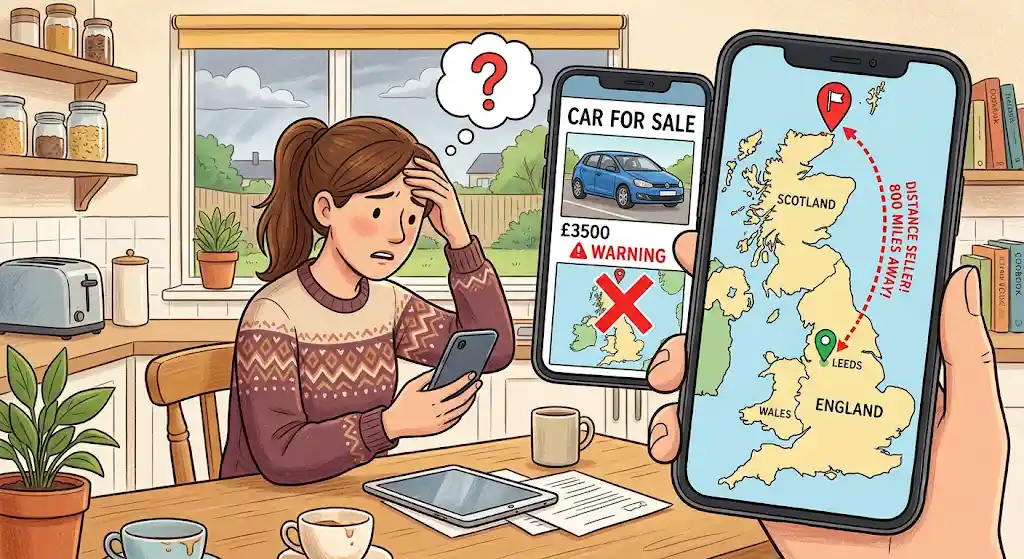
You've found it. The exact spec, the right colour, one owner, low miles — and somehow £1,500 under everything comparable. There's just one tiny detail: the car is in Thurso. Or Belfast. Or a farm “just outside” Aberdeen. You're in Kent. And the seller, helpfully, has a solution for that.
Distance is the most under-rated red flag in used car buying — not because people in Scotland and Northern Ireland don't sell honest cars (they sell thousands), but because scammers deliberately choose a location you'll never visit. The whole con depends on one thing: you not standing in front of the car. Put 400 miles between you and the metal, and every other check you'd normally do quietly dies of inconvenience.
Why the scam needs the miles
Think about what distance does to your behaviour: You can't just pop round for a look. Every physical defence you have gets replaced by photos the seller chose and words the seller wrote.
And then comes the pivot — the line every version of this scam eventually reaches:
“No need to travel — I can have it delivered. Just a small deposit to hold it.”
We're used to shopping online these days: Amazon groceries, eBay,ASOS fast fashion. So a lot of people are lulled into a false sense of security. And the deposit is the entire point. The car — if it ever existed — is photos lifted from a real advert, often with the plates blurred so you can't check the history. The “courier service” is a template website. The “escrow company” protecting your money is the scammer's other email address. Once the bank transfer lands, the listing vanishes, the number goes dead, and the same car goes back up for sale 300 miles from its next victim.
The four flavours of far-away
The ghost car
The car doesn't exist. Photos are stolen from a genuine listing, the price is set 20-30% under market to generate urgency, and the location is chosen to be maximally awkward — an island, a remote town, "working offshore at the moment." Every conversation funnels toward a deposit.
The oil-rig widower
A long, emotional backstory: working on a rig, emigrating next week, late husband's car she can't bear to see. The story exists to explain why you can't view it and why a "shipping company" will handle everything. Real sellers don't need a courier to sell a car; they need a buyer with legs.
The very real, very broken car
The car exists — that's the trap. It's a genuine vehicle in a genuine far-away place, priced to make the 700-mile round trip feel justified. When you arrive, exhausted and invested, it's rougher than the photos, and the seller knows you won't go home empty-handed after ten hours of driving. Distance here isn't hiding the car; it's weaponising your sunk costs.
The clone at a distance
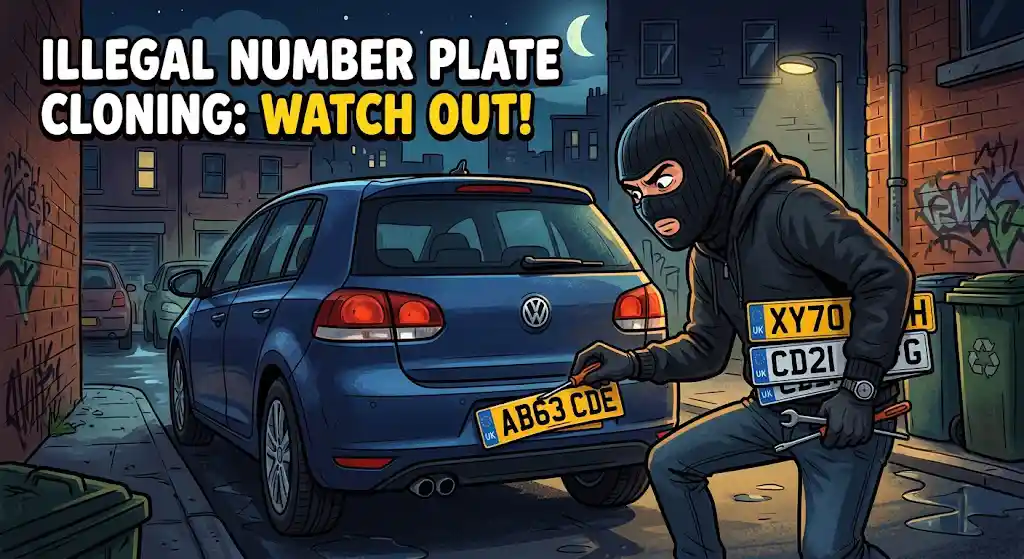
A stolen car wearing the plates of an identical clean one registered far away. The distance stops you doing the one check that unravels it: standing at the registered keeper's address, matching the V5C to the person and the house. You're asked to meet "halfway" in a services car park instead.
The one rule that beats all four
Never send money to a car you haven't stood next to.
Not a deposit, not a “holding fee”, not a courier charge, not an escrow payment. No legitimate private sale requires money to move before you've seen the car, sat in it, and matched the V5C to the seller. A genuine seller with a genuine car will wait 48 hours for a genuine buyer. Anyone applying time pressure to a bank transfer is telling you exactly what they are.
And if the car is real but remote? Then treat the distance as a cost of the car. Add the train ticket, the day off, and the recovery-truck-if-it-goes-wrong to the price, and suddenly that £1,500 saving is £400 — for a car you can't easily take back to the seller. Sometimes the maths still works. It just almost never works as well as the advert wants you to believe.
Your long-distance defence kit
Get the reg before anything else
A seller who blurs, crops or refuses the registration is refusing to let you check the car. That's a complete answer in itself. A real seller hands it over without blinking.
Run the history from your sofa
Thirty seconds on the free check tells you the car exists, its MOT story, and whether the mileage adds up. The £4.99 full check adds write-off, finance, stolen markers and keeper history — everything a ghost listing can't survive.
Reverse-search the photos
Stolen listing photos usually surface on the original advert. If the same Golf is for sale in Thurso and Torquay simultaneously, you've found your answer.
Demand a live video walkaround
Not a pre-recorded clip — a live video call where you direct: "show me the plate, the VIN by the windscreen, the dashboard with the engine running, today's newspaper." A scammer with stolen photos can't do any of it.
If you go, go like a professional
Viewing at the seller's home address (never a car park), V5C name and address matched to the person and house, and payment only after inspection — same rules as ever, no matter how far you've come.
The check that works at any distance
Everything physical about buying a car gets harder with distance — except the history check. BuyCarCheck works exactly the same whether the car is next door or on Orkney, and it's the single filter that catches ghost listings, clones and hidden write-offs before you've spent a penny or a mile. Run it first. Travel second. Pay last.
The 300-mile bargain is occasionally real. But the seller who's relying on those miles — to stop the viewing, hurry the deposit, or exhaust you into nodding — has told you everything. Distance isn't just geography. In a used car advert, it's a strategy. Make sure it isn't one being used on you.
Found this useful?
A £4.99 check could save you thousands
Run a free basic check, or save money with a bundle — check three cars for just £11.99
Check before you buy
Finance · Write-off · Stolen · Keeper history